


 Cart
Cart
 sales@molnova.com



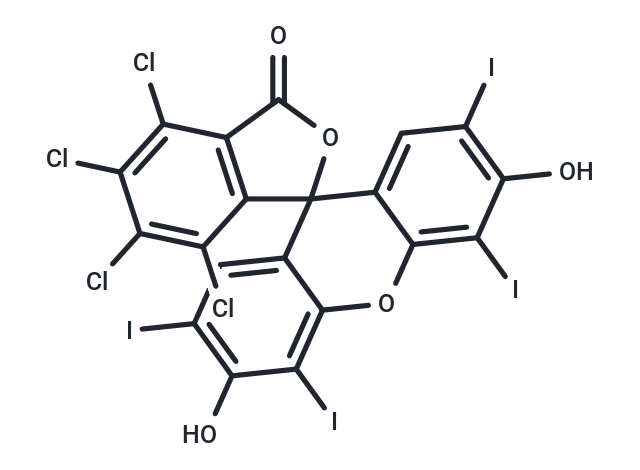
Rose bengal lactone
CAS No. 4159-77-7
Rose bengal lactone( —— )
Catalog No. M37592 CAS No. 4159-77-7
Rose bengal lactone (C.I. Solvent Red 141) is a rose bengal lactone stain commonly used to stain the nuclei of plant and animal cells.
Purity : >98% (HPLC)
 COA
Datasheet
HNMR
HPLC
MSDS
Handing Instructions
COA
Datasheet
HNMR
HPLC
MSDS
Handing Instructions
| Size | Price / USD | Stock | Quantity |
| 2MG | 296 | Get Quote |


|
| 5MG | 459 | Get Quote |
|
| 10MG | 657 | Get Quote |
|
| 25MG | 994 | Get Quote |
|
| 50MG | 1371 | Get Quote |
|
| 100MG | 1773 | Get Quote |
|
| 500MG | Get Quote | Get Quote |
|
| 1G | Get Quote | Get Quote |
|
Biological Information
-
Product NameRose bengal lactone
-
NoteResearch use only, not for human use.
-
Brief DescriptionRose bengal lactone (C.I. Solvent Red 141) is a rose bengal lactone stain commonly used to stain the nuclei of plant and animal cells.
-
DescriptionRose bengal lactone (C.I. Solvent Red 141) is a rose bengal lactone stain commonly used to stain the nuclei of plant and animal cells.
-
In Vitro——
-
In Vivo——
-
Synonyms——
-
PathwayOthers
-
TargetOther Targets
-
RecptorOthers
-
Research Area——
-
Indication——
Chemical Information
-
CAS Number4159-77-7
-
Formula Weight973.67
-
Molecular FormulaC20H4Cl4I4O5
-
Purity>98% (HPLC)
-
Solubility——
-
SMILESO=C1OC2(C3=CC(I)=C(O)C(I)=C3OC4=C(I)C(O)=C(I)C=C42)C=5C(Cl)=C(Cl)C(Cl)=C(Cl)C15
-
Chemical Name——
Shipping & Storage Information
-
Storage(-20℃)
-
ShippingWith Ice Pack
-
Stability≥ 2 years
Reference
molnova catalog



related products
-
Fmoc-N-PEG7-acid
Fmoc-N-amido-PEG7-acid is a PEG-based PROTAC linker that can be used in the synthesis of PROTACs.
-
Murrangatin
Murrangatin may be a valuable anti-tumor-promoting agent, it can significantly inhibit Epstein-Barr virus early antigen (EBV-EA) activation, and preserve the high viability of Raji cells, it also exhibits cytotoxicity against cholangiocarcinoma cell line, KKU-100.
-
3-Oxo-C14-AHL
N-(3-Oxotetradecanoyl)-DL-homoserine lactone, part of the N-Acyl homoserine lactone (AHL) family derived from gram-negative bacteria, serves as a quorum sensing (QS) signaling molecule.
